



Since Google launched in 1998, the phrase "just Google it" has become synonymous with online search itself. But today a new shift is underway, and it’s arguably just as transformative.
More people are turning to AI-powered tools like ChatGPT, Claude, Gemini, Perplexity, and Copilot not just to answer questions, but to discover brands, compare services, and make purchasing decisions.
The days when Google was the only gatekeeper to your online presence are over. The question for businesses now is: Do you know where your brand is showing up when people ask AI for recommendations?
The reality is that AI platforms have become parallel search engines. Users are asking these tools questions, such as:
- "What companies are best for [problem]?"
- "Compare Brand X to the leading companies in [category]."
And if your brand isn't part of those AI-generated responses, you're missing out on a rapidly growing channel of discovery.
Traditional SEO taught us to optimize for how Google perceives your brand. Now, we need to think about how AI models perceive, reference, and recommend your brand. This marks a fundamental shift in how people discover and evaluate brands online.
We’re Already Seeing Real Results from AI Referrals
While Google still represents the primary driver for most website traffic, we're starting to see meaningful increases in AI-driven referrals across our client portfolio.
Take one example: a local safety manufacturer whose invested in AI optimization (AIO). Not only were we able to establish their presence in AI Search results, but we've also achieved an upward trend in traffic from these AI sources.
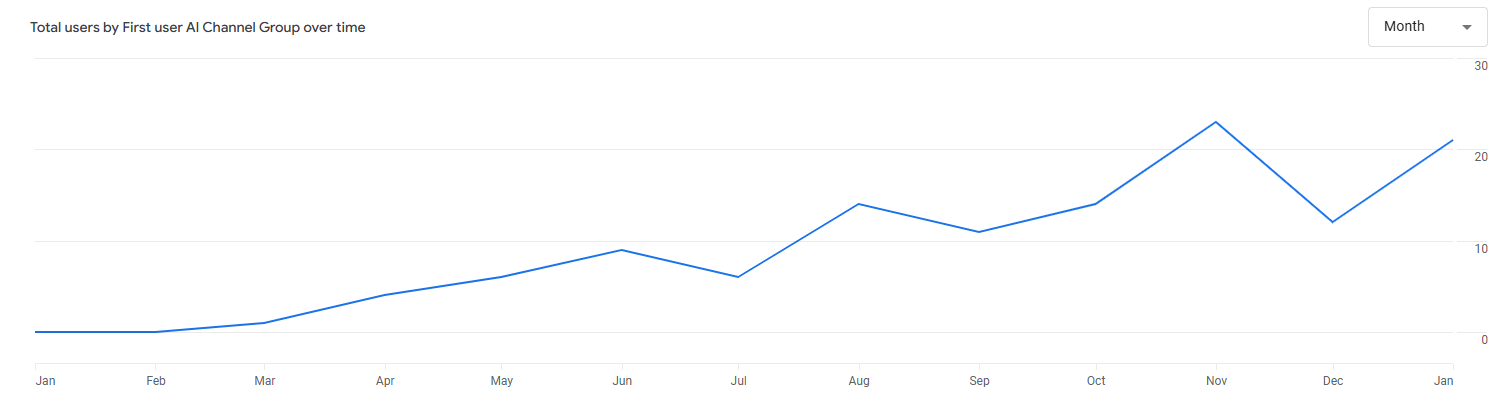
The volumes are still smaller than traditional search, but the upward trajectory is clear and accelerating.
How to Check Where Your Brand Shows Up in AI Results
The Old-Fashioned Way: Manual Prompting
The simplest approach is to go directly to your AI tool of choice and feed it strategic prompts. Try prompts like:
- Which companies are commonly associated with solving [problem], and why?
- Compare Brand X to the leading companies in [category].
- If a user is looking for [specific intent], which brands would you recommend and why?
- What sources would you cite when explaining [topic] to a user?
Pay attention to whether your brand appears at all, where it appears in the response (first mention vs. buried deep), how it's framed (positive, neutral, or negative sentiment), and which citations or sources are referenced. This will give you a general perception of how these AI models view your brand relative to competitors.
AI Visibility Tracking Tools
Manually entering prompts is helpful for spot-checking, but it doesn't give you a comprehensive view or allow you to benchmark against competitors over time. With dozens of AI models, thousands of possible queries, and countless prompt variations out there, tracking AI visibility manually would quickly become a cumbersome, never-ending task.
Thankfully, the SEO and marketing technology landscape has evolved to meet this need. There are now specialized tools designed to monitor how your brand is perceived across AI platforms at scale. Some of the most notable include:
- Ahrefs Brand Radar: monitors brand mentions across AI-generated responses
- SEMRush AI Visibility Toolkit: tracks AI visibility and provides competitive insights
- SE Rankings AI Visibility Tracker: analyzes your presence across multiple AI platforms
These platforms allow you to view brand perception and sentiment at scale, along with specific prompts that are triggering mentions of your brand. Instead of manually testing dozens of queries yourself, these tools automatically track hundreds or thousands of relevant searches and show you exactly where you appear (and where you don't).
Key metrics you can track include:
- Share of Voice: How often is your brand showing up in AI answers compared to your competitors?
- Sentiment: How does AI talk about you? Is the tone positive, negative, or neutral?
- Prompt Tracking: Which specific questions and queries are triggering mentions of your brand?
Understanding AI Traffic: What Happens After Discovery?
Getting discovered by AI and receiving traffic to your website is only part of the equation. Discovery is meaningless if those visitors don't convert. The more important questions are: What happens after visitors arrive? What do they do? What valuable actions do they take?
This is where web analytics tools become invaluable. Platforms like Google Analytics 4 allow you to isolate and analyze AI-referred traffic separately from your traditional search and referral sources. By creating filtered reports and custom segments, you can drill down into the traffic that came from AI platforms and analyze:
- Engagement levels: How long do AI-referred visitors stay on your site? How many pages do they view?
- Conversion actions: Are they filling out forms, making purchases, downloading resources, or taking other valuable actions?
- User journey patterns: Where do they go after landing? What content resonates with them?
This level of analysis helps you understand not just if AI is sending you traffic, but whether that traffic is valuable.
How We Help Clients Win in the AI Era
At JH, we're committed to helping our clients succeed in this evolving landscape of AI-driven discovery. Our approach focuses on four core pillars that work together to maximize your AI visibility and the business results that come from it:
Get Discovered
We optimize your website content and digital presence so AI models can easily find, understand, and reference your brand. This involves creating high-quality content that AI systems recognize as valuable and trustworthy.
AI Friendly Content
Once we have quality content in place, we add the technical and non-technical components that AI models prioritize. These components make it easier for AI systems to crawl, process, and accurately reference your content.
Be an Authority
We help position your website and content as an authoritative source in your industry, making it more likely that AI platforms will cite and recommend your brand when users ask relevant questions.
Drive Traffic
We implement strategies to increase the volume and quality of traffic funneled to your website from AI sources, ensuring that when people discover you through AI, they actually visit your site and take meaningful actions.
The AI Advertising Landscape
Like the search engines' business model, most of the major AI platforms have been exploring the advertising model to open an additional revenue stream for their platforms.
Each platform is at a different stage and taking different stances when it comes to advertising:
ChatGPT: Testing Ads in the US
As of February 9, 2025, OpenAI has started testing ads for the Free and Go tiers of ChatGPT. This will be a phased approach, starting with select categories and advertisers. Ads will be clearly marked and appear at the bottom of chat responses rather than being woven into the AI responses.
Claude: Taking a Stand Against Ads
Contrary to ChatGPT’s approach, Claude has explicitly committed to remaining ad-free. This announcement came in the form of a Super Bowl ad, making it clear that ads will not be coming to their platform.
Gemini: Not Yet, But Google is Watching
Google has been experimenting with ads in its AI Overviews and AI Mode features within Google Search, but according to Dan Taylor, Google's VP of Global Ads, there are no current plans to bring ads into Gemini itself.
That said, Google's advertising DNA runs deep, and I would be surprised if they don't eventually explore monetization options for Gemini as the product matures.
Perplexity: Early Mover, Now in Closed Pilot
Perplexity was one of the first AI platforms to launch advertising, rolling out ads in November 2024 and partnering with major brands like Indeed and Whole Foods. But as of October 2025, Perplexity has stopped accepting new advertisers, and the program remains a closed pilot.
Microsoft Copilot: Leveraging Existing Ads Infrastructure
Advertisers using the Microsoft Advertising Platform are already eligible to have their ads appear at the end of Microsoft Copilot responses. This integration leverages Microsoft's existing advertising infrastructure and relationships, making it relatively seamless for current Microsoft advertisers to extend their campaigns into Copilot.
Adapt Now or Fall Behind
The shift to AI-driven discovery is here. The question isn't whether this trend will continue, but how quickly it will accelerate and whether your brand will be visible when it matters most.
The good news is that many of the fundamentals still apply. Creating high-quality, authoritative content that genuinely helps your audience has always been the foundation of effective digital marketing. AI just raises the bar for what "high-quality" means and creates new channels through which that content can be discovered.
Work with a Team that Understands AI
If you are interested in learning more about how AI search is reshaping your brand visibility, our team can help. We work with companies to help them increase their digital presence with AI, be viewed as an authoritative source for relevant industry queries, and drive quality traffic from AI sources.